Electric Auto Subsidy in India (2026): How to Claim Your EV Discount
Electric Auto Subsidy in India (2026): How to Claim Your EV Discount
Introduction
Are you planning to buy an electric auto but worried about the upfront cost? There is great news for Indian auto drivers and transport business owners: the government wants you to switch to green mobility, and they are willing to pay a portion of the vehicle’s price to make it happen.
Understanding the electric auto subsidy can save you tens of thousands of rupees. However, with old schemes like FAME II officially ended and new schemes taking over, finding accurate, up-to-date information can be confusing.
Here is your complete, easy-to-understand guide to electric three-wheeler subsidies in 2026, explaining exactly how much money you can save and how to get your discount instantly.
Central Government Subsidy: The PM E-DRIVE Scheme Explained
In late 2024, the central government launched the PM E-DRIVE scheme, a massive ₹10,900 crore initiative that replaces the older FAME II policy. Under this active scheme, you receive a direct cash discount on your vehicle based on its battery capacity.
For commercial electric three-wheelers, the PM E-DRIVE subsidy is broadly categorized into two segments:
Basic E-Rickshaws & E-Carts (L3 Category): For standard, low-speed battery rickshaws and loaders, you can receive a central subsidy of up to ₹25,000.
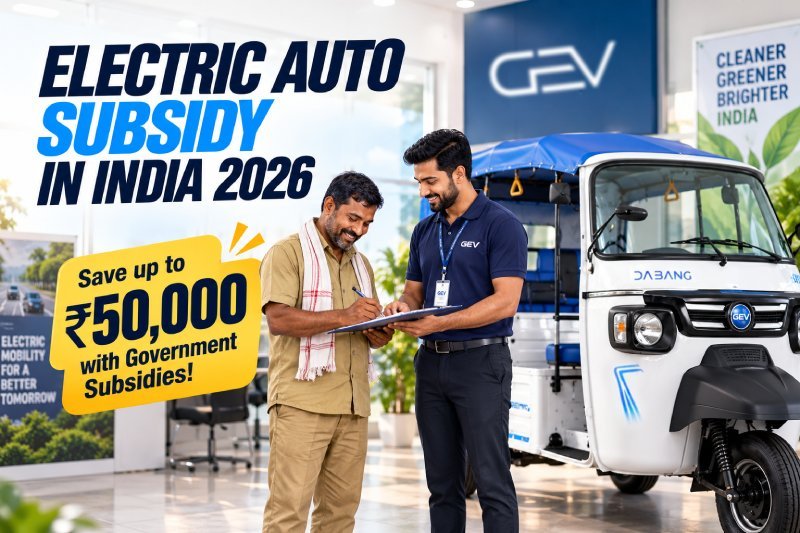
Heavy-Duty Electric Autos (L5 Category): For larger, high-speed passenger autos and heavy cargo loaders built to replace CNG autos, the central subsidy goes up to ₹50,000.
Important Note: The central cash subsidy is designed to promote advanced technology. Therefore, these specific PM E-DRIVE cash discounts are generally available for vehicles equipped with modern Lithium-ion batteries.
State-Level Subsidies: Extra Savings in Your City
The best part about buying an electric auto is that you can often combine (or “stack”) the central government subsidy with your own state government’s EV policy.
While state policies change periodically, many regions offer massive extra incentives for commercial EV buyers:
Delhi: Offers some of the most aggressive EV incentives in the country, including direct purchase incentives of up to ₹30,000 for e-autos and e-rickshaws, plus additional scrapping incentives if you exchange an old polluting vehicle.
Maharashtra, Gujarat, & Tamil Nadu: These states have rolled out localized policies that offer direct cash discounts, early-bird incentives, or generous fee waivers specifically for electric three-wheelers.
Because state subsidies vary, it is always best to check with your local dealership to see the exact cash discount currently active in your city.
Hidden Savings: GST, Road Tax, and Income Tax Benefits
Beyond direct cash subsidies, the government actively reduces your electric auto price through massive tax cuts. These hidden savings often add up to more than the cash subsidy itself:
Low GST: While traditional petrol and diesel commercial vehicles can face high GST rates (up to 28%), the government has slashed the GST on electric vehicles to a flat 5%.
100% Road Tax & Registration Waiver: To encourage EV adoption, several major states—including Delhi, Maharashtra, Uttar Pradesh, and Telangana—have completely waived road tax and RTO registration fees for electric vehicles. This alone eliminates a huge chunk of your on-road price.
Income Tax Benefits: If you take a business loan to purchase your commercial EV, you may be eligible to claim tax deductions of up to ₹1.5 Lakh per year on the loan interest under Section 80EEB of the Income Tax Act.
How to Claim Your Electric Auto Subsidy
Claiming your subsidy is incredibly easy. You do not need to visit government offices, run behind RTO officials, or fill out complicated online forms at home. The process is handled entirely at the showroom:
Aadhaar Linking: Make sure your Aadhaar card is linked to your active mobile number before visiting the showroom.
Select an Approved Vehicle: Choose a subsidy-eligible vehicle that is officially certified by government testing agencies (like ICAT).
Instant Dealership Discount: The dealer will log into the PM E-DRIVE portal, complete an Aadhaar-authenticated e-KYC, and generate an e-Voucher sent to your mobile phone.
Pay the Lower Price: The subsidy amount is deducted upfront from your final bill. You only pay the reduced on-road price, and the government later reimburses the manufacturer.
Maximize Your Profit with GEV Electric Autos
To take full advantage of these government incentives, you need a vehicle that is fully approved, certified, and built to last. Gayatri Electric Vehicles (GEV) offers a robust lineup of subsidy-eligible electric three-wheelers designed for Indian roads:
Dabang MaxX (8-Seater): Maximize your passenger income with this high-capacity (7 passengers + 1 driver) L5 electric auto.
Entrega HD+ & Dabang Flexi: Heavy-duty cargo loaders built to handle 500 KG to 700 KG, perfect for logistics operators looking to leverage commercial EV incentives.
Dabang Pro & Eco: Highly reliable, affordable options for everyday city routes.
When you purchase an eligible GEV electric auto, our trusted dealer network handles all the subsidy paperwork for you, ensuring you get your maximum discount instantly.
Ready to calculate your exact savings? Visit a GEV Dealership today. Our team will help you find the right vehicle, calculate your central and state subsidies, and arrange easy financing so you can start earning “Bada Munafa” immediately!
FAQ
Q1: Is the FAME II subsidy still active in 2026?
A: No, FAME II has been replaced by the PM E-DRIVE scheme, which now governs central subsidies for electric vehicles in India.
Q2: How much is the central subsidy for an electric auto?
A: Under the PM E-DRIVE scheme, you can get up to ₹25,000 for standard L3 e-rickshaws, and up to ₹50,000 for larger L5 category electric autos, provided they use advanced batteries like Lithium-ion.
Q3: Do I have to pay road tax on an electric auto?
A: In many major states like Delhi, Maharashtra, UP, and Telangana, the government has completely waived the road tax and registration fees for electric vehicles, saving you a lot of money upfront.
Q4: How does the subsidy money reach me?
A: You don’t have to wait for a refund. The subsidy is applied as an instant, upfront discount at the dealership. You just pay the reduced final price, and the dealership claims the money back from the government.
Q5: Can I get a bank loan on the subsidized price?
A: Yes! Banks and NBFCs will finance the vehicle based on its final on-road price (after the subsidy is deducted). Plus, you can claim income tax benefits on the loan interest under Section 80EEB.