Is the Real EV Revolution Happening in the Commercial Segment?
Is the Real EV Revolution Happening in the Commercial Segment?
Introduction
While sleek electric hypercars and luxury passenger EVs often dominate the headlines, a quieter—and much larger—transformation is taking place on our city streets and logistics routes. The real electric vehicle (EV) revolution isn’t just parked in residential driveways; it is actively delivering our packages, shuttling our daily commutes, and hauling commercial freight.
In 2026, the global electric commercial vehicle market has entered a phase of explosive growth, with market size projections pointing toward $166 billion by the early 2030s. The narrative has decisively shifted. For businesses, adopting EVs is no longer just a corporate sustainability talking point—it is a fundamental economic advantage.
Here is a closer look at why the commercial segment is becoming the true engine of the EV revolution.
The Economics of Electrification
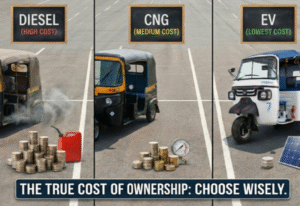
The primary driver behind commercial EV adoption is pure mathematics. Fleet operators make purchasing decisions based on the Total Cost of Ownership (TCO), and the scales have officially tipped in favor of electric mobility.
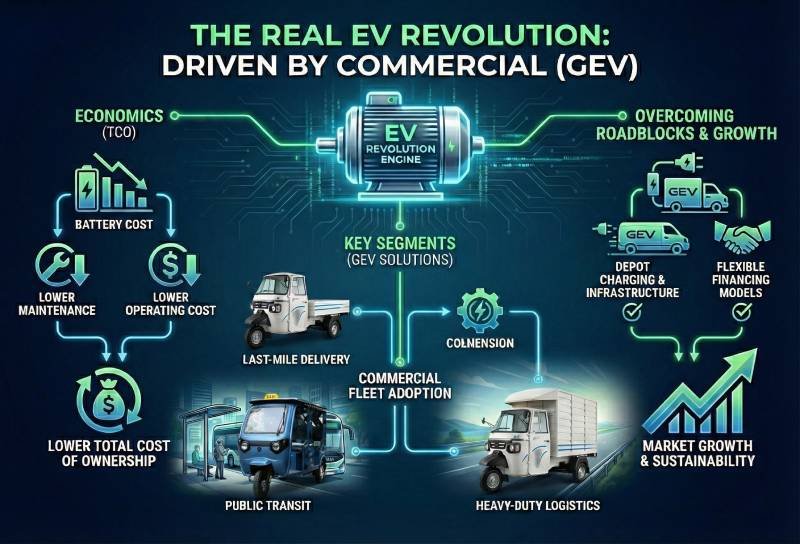
Plummeting Battery Costs: The cost of lithium-ion batteries has dropped dramatically over the last decade and is pushing toward the $80/kWh mark in 2026. This reduction drastically lowers the upfront capital required to purchase commercial EVs, making them competitive with traditional diesel vehicles.
Reduced Operating Expenses: Electric motors have significantly fewer moving parts than internal combustion engines, translating to lower maintenance, servicing, and repair costs. Combined with cheaper electricity rates compared to fluctuating fossil fuel prices, the operational savings are immediate.
Service-Led Models: The rise of Battery-as-a-Service (BaaS) and robust battery-swapping networks has further reduced upfront costs for commercial users by as much as 40% to 50%. Businesses can now treat energy as a predictable operating expense rather than a massive capital investment.
Key Segments Driving the Charge
The commercial EV revolution is not a monolithic trend; it is unfolding rapidly across several distinct vehicle categories, each driven by unique operational needs.
Last-Mile Delivery and LCVs
The explosion of e-commerce and quick-commerce platforms has made last-mile delivery a prime candidate for electrification. Global logistics giants and food delivery networks are aggressively electrifying their fleets. Light commercial vehicles (LCVs), delivery vans, and electric two- and three-wheelers are perfectly suited for urban environments where stop-and-go traffic is the norm and route distances are predictable.
Municipal and Transit Buses
Public transit is leading the zero-emission mandate. In many global markets, electric buses already account for more than half of all new municipal bus purchases. Driven by strict city-level emissions regulations and government subsidies aimed at improving urban air quality, transit authorities are bulk-purchasing electric fleets and establishing dedicated depot charging infrastructure.
The Heavy-Duty Horizon
While heavy-duty long-haul trucks remain the toughest segment to electrify due to battery weight and range limitations, significant progress is underway. Innovations in battery chemistry, such as high-density solid-state electrolytes, alongside the deployment of megawatt fast-charging corridors, are beginning to make electric freight viable for regional transport.
Overcoming the Roadblocks
Despite the massive momentum, the transition to commercial electric fleets still faces infrastructural and financial hurdles.
Charging Infrastructure: While passenger EVs can often rely on home or destination charging, commercial fleets require robust, high-capacity depot charging or highly reliable public fast-charging networks to prevent route disruptions and downtime.
Financing and Bankability: For small fleet owners, gig workers, and independent operators, accessing capital remains a bottleneck. However, as lenders gather more data on battery degradation and residual vehicle values, specialized EV financing models and flexible loan structures are rapidly emerging to bridge this gap.
The Bottom Line
The commercial sector has successfully transformed electric mobility from an aspirational consumer choice into everyday business infrastructure. By prioritizing high utilization rates, predictable charging behaviors, and data-governed fleet management, commercial operators are proving that EVs are built for the heavy lifting.
As technology improves, charging networks expand, and policy support continues, the commercial segment will not just participate in the EV revolution—it will be the force that pulls the rest of the industry forward.