Electric Mobility as a Business Opportunity
Powering Profits: Electric Mobility as the Ultimate Business Opportunity in India
Introduction
The transportation landscape in India is undergoing a monumental shift. What started as a collective push toward a greener, zero-emission future has rapidly evolved into one of the most lucrative commercial opportunities of the decade. Today, Electric Mobility is no longer just an environmental imperative—it is a powerful engine for economic growth, particularly in the realm of last-mile connectivity.
Whether you are an individual driver seeking better daily earnings, an entrepreneur looking to start a logistics fleet, or an established business aiming to slash transportation overheads, electric vehicles (EVs) offer an unmatched proposition. Here is a look at why electric mobility is the smartest business opportunity today, and how you can capitalize on it.
1. The Economic Edge: Drive “Bada Munafa” (Big Profits)
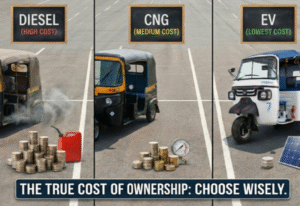
The core of any successful transport business is the margin between revenue and operational costs. Traditional diesel and CNG vehicles are burdened by volatile fuel prices and high maintenance expenses.
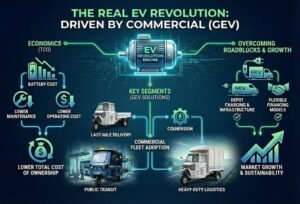
In contrast, commercial EVs fundamentally change the profit equation. For instance, an electric auto runs at less than ₹0.70 per kilometer, compared to the ₹3 to ₹4 per kilometer cost of a diesel or CNG equivalent. That translates to an immediate reduction in daily operational costs by up to 80%. Furthermore, with fewer moving parts, EVs require significantly less maintenance. Lower running costs and reduced downtime equal immediate, scalable, and sustainable profit.
2. The Boom in Last-Mile Logistics
With the exponential growth of e-commerce, hyper-local deliveries, and quick commerce in India, the demand for efficient cargo transport is at an all-time high. Companies are actively seeking logistics partners who can deliver goods affordably and sustainably.
Heavy-duty electric loaders are perfectly positioned to meet this demand. Vehicles capable of handling massive payloads—such as the 700 KG capacity of the Entrega HD+ or the 500+ KG capacity of the Dabang Loader—allow business owners to seamlessly execute B2B and B2C deliveries. For entrepreneurs, building a fleet of electric cargo vehicles opens up steady contract opportunities with major supply chain and retail companies.
3. Revolutionizing Passenger Transport
India moves on its three-wheelers, and electric autos are redefining urban commutes. Drivers and fleet operators are experiencing a surge in demand for shared mobility. By adopting high-capacity electric passenger vehicles—like India’s first 7+1 seater electric auto, the Dabang MaxX, or the agile 3+1 Dabang City—operators can carry more passengers per trip. Coupled with a real-world range of 150+ km on a single charge, drivers can operate for a full day without the anxiety of constant recharging, directly multiplying their daily income.
4. Smart Fleet Management with IoT
Modern electric mobility isn’t just about the hardware; it is deeply connected via software. For fleet operators, managing vehicles traditionally meant dealing with blind spots in driver behavior, fuel theft, and sudden breakdowns.
Today’s smart EVs are essentially IoT devices on wheels. Platforms like GEV Connect give business owners complete control over their fleets. With features like precision live tracking, battery health monitoring (State of Charge, Temperature), route history, and geofencing, business owners can optimize delivery paths, predict maintenance, and ensure 99.9% uptime.
5. Government Support and Subsidies
The Indian government is aggressively promoting EV adoption through favorable policies, subsidies, and tax benefits at both the central and state levels. Lower GST rates on EVs, easier financing options, and the push for public charging infrastructure make the initial capital expenditure highly accessible. For a business, this lowers the barrier to entry and shortens the break-even period significantly.
The GEV Advantage: Your Partner in Growth
At Gayatri Electric Vehicles (GEV World), we don’t just manufacture electric vehicles; we engineer dependable business solutions tailored for Indian roads. Established in 2016, our mission has always been to empower livelihoods through green innovation.
Here is why businesses trust the GEV fleet:
Built Tough for India: Our EVs feature rugged, anti-rust metal bodies designed to withstand tough terrains and heavy workloads.
Advanced Battery Tech: Equipped with superior LFP and Lithium-ion batteries, our vehicles charge fully in just 4 to 5 hours, ensuring your vehicles spend more time on the road and less time plugged in.
Make in India: Locally sourced components ensure readily available spare parts and seamless after-sales support through our robust Pan-India dealer network.
ICAT Approved Safety: Every model undergoes rigorous testing to guarantee passenger and cargo safety.
Conclusion
The transition to electric mobility is inevitable, but the real winners will be those who adopt it early. By investing in electric passenger autos or heavy-duty cargo loaders, you are future-proofing your business, protecting the environment, and setting yourself up for long-term financial success.
Are you ready to redefine your earning potential and step into the future of transport? Explore our diverse range of commercial electric vehicles at gevworld.com and start your journey toward sustainable success today!